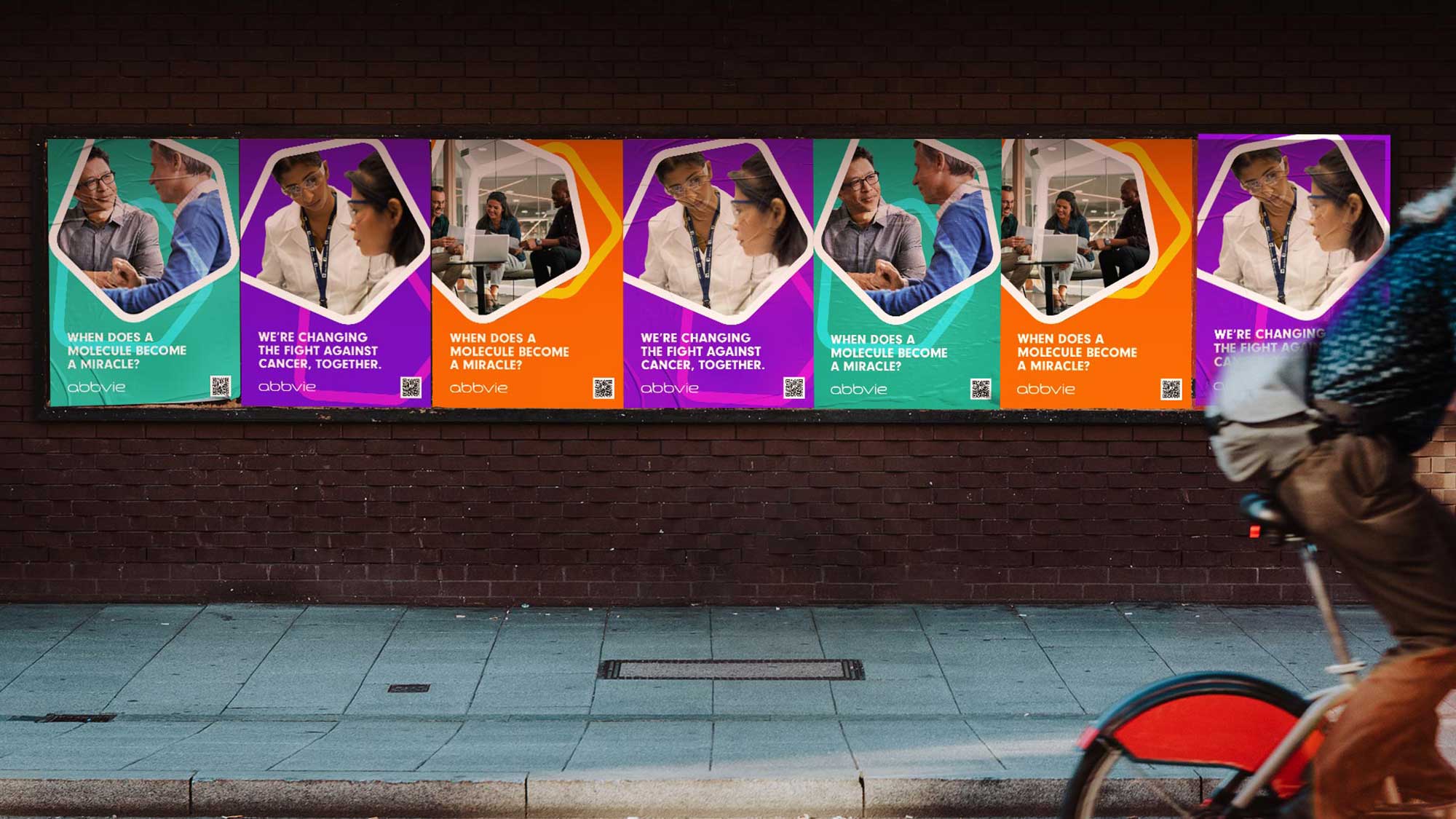
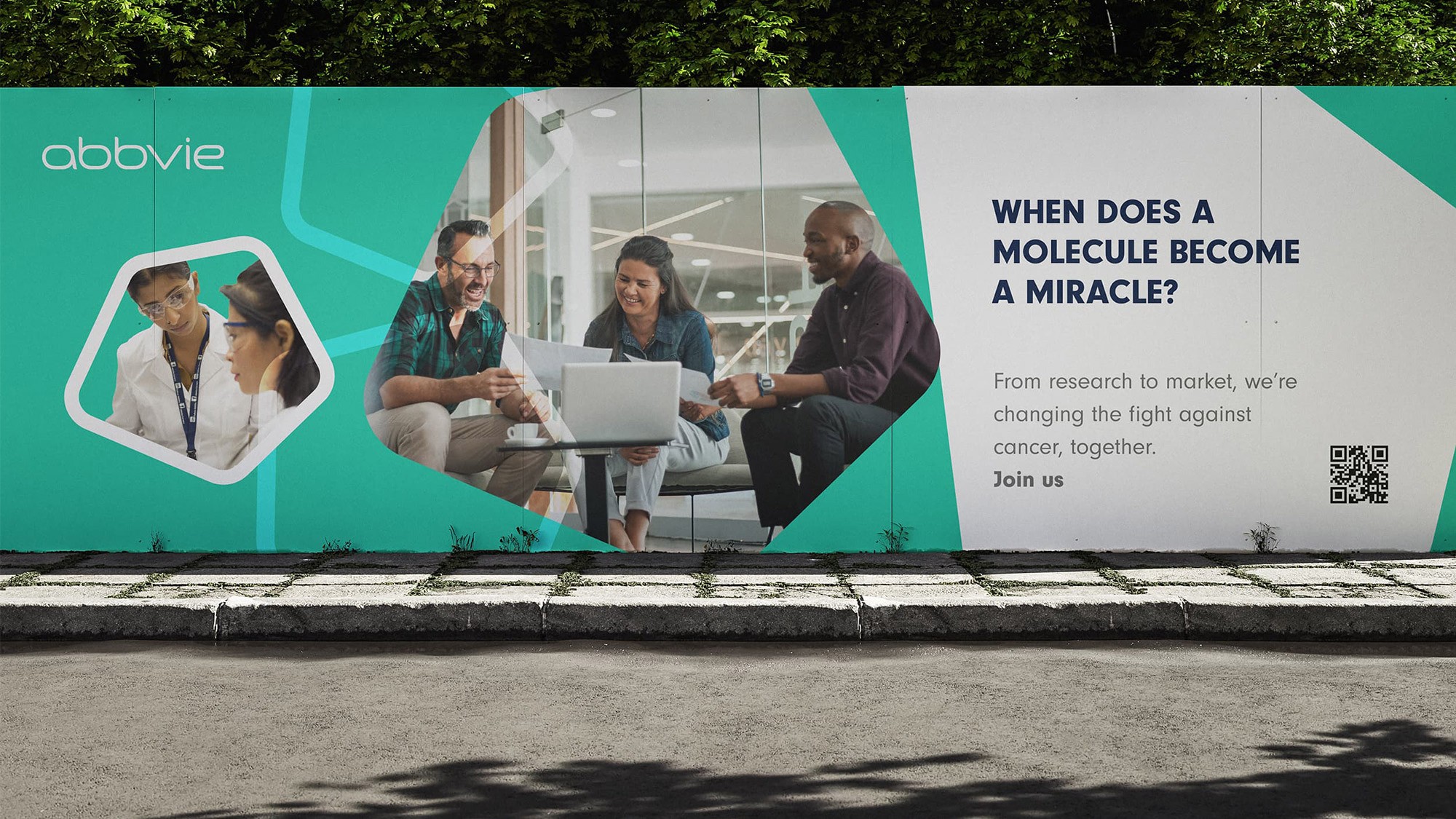
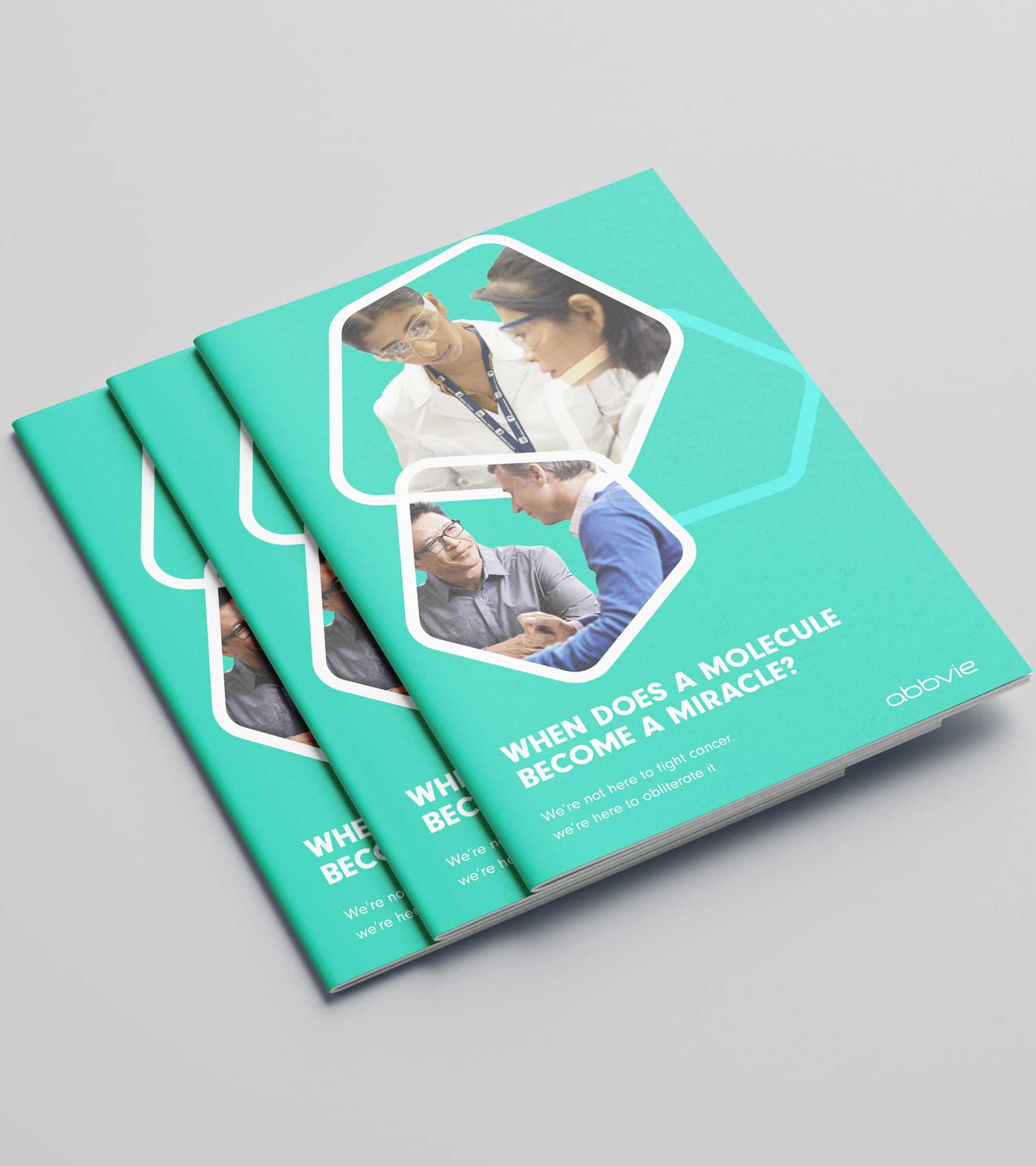
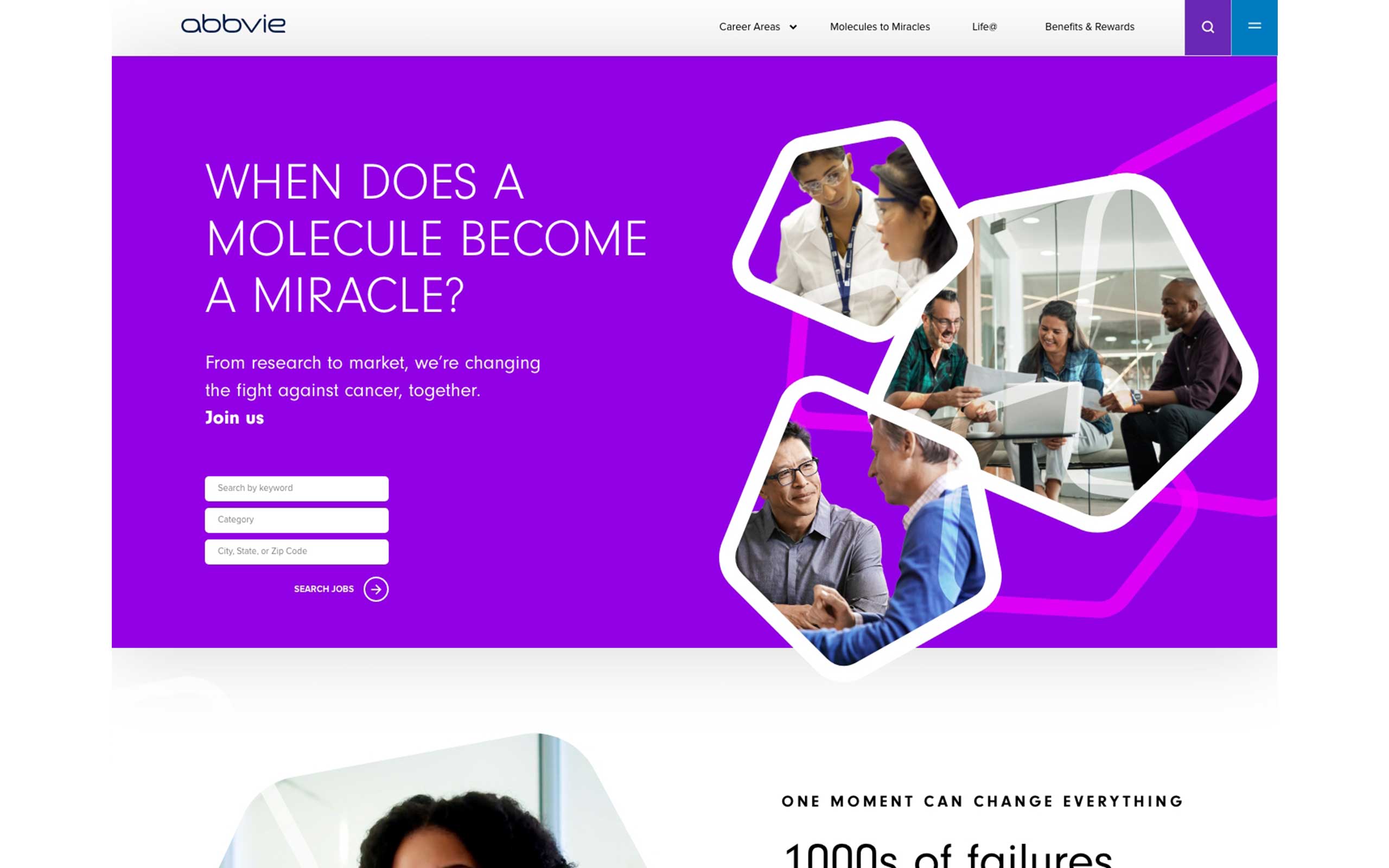
Abbvie outdoor advertising example

AbbVie

Everyone Here Is in the Miracle Business

Focus:

Employer Brand Transformation & Value Strategy Development

Key Elements:

Decision-Dynamics Research, Creative Direction, Content Strategy, UX Design, Career Site Reinvention, Storytelling.

The Challenge

AbbVie operates in more than 70 countries across five global regions. It is one of the world's major players in biopharmaceuticals — a company whose science has meaningfully improved and extended human lives. But it lacked the mainstream public presence of competitors whose medicines had become household names. Most people outside the industry had never heard of it.

That recognition gap didn't matter much inside the lab. Scientists and researchers who cared about drug discovery knew exactly who AbbVie was and what working there could mean for their careers. But recruiting at the scale and breadth a company like AbbVie requires means competing for far more than scientists. Logistics, supply chain, regulatory affairs, commercialization, finance, operations — the full architecture of a global enterprise depends on people who may never have heard of the company and have no particular reason to seek it out.

Against competitors with household-name medicines and established employer brand reputations, AbbVie was invisible to the talent audiences it needed most. The disadvantage wasn't in what the company offered. It was in the story the company wasn't telling.

Collage of Abbvie images
Abbvie digital ad example

Finding the Insight

We surveyed more than 10,000 employees across AbbVie's global regions to understand where the company was creating genuine career value and where the gaps were between what it delivered and how it was perceived. The picture that emerged was both clarifying and, in its own way, reassuring.

The gap wasn't in the offering. AbbVie was delivering. The day-to-day experience employees described was strong. Purpose was real. Collaboration was genuine. Commitment to outcomes — not just commercial outcomes but human ones — ran deep across functions and regions. The recruiting disadvantage wasn't rooted in a broken culture or a hollow promise.

What employees kept saying, across geographies and job families and levels, was a version of the same thing: AbbVie doesn't just promise — they follow through.

The insight was straightforward and consequential: this wasn't an employee experience problem. It was a storytelling problem. A company with a genuinely compelling culture and a deeply held sense of purpose had never figured out how to express it in language that reached beyond the people who already worked there.

There was a second layer. AbbVie had a well-earned reputation for drug discovery — the scientists got the story. But the path from a promising molecule to a medicine that reaches a patient in the real world involves hundreds of functions and thousands of people who never set foot in a lab. Those roles were invisible in AbbVie's employer narrative, which meant the people who filled them had no framework for understanding how their work connected to the company's mission. The culture was already there. The language wasn't.

Abbvie brand collateral
Collage of PCH healthcare employees with children patients

The Strategy

We reframed AbbVie's employer value proposition around a single question: When does a molecule become a miracle?

The line did several things simultaneously. It acknowledged AbbVie's scientific heritage without making science the only story. It framed the company's work as consequential — not in a corporate aspiration sense, but in a literal, observable way. And it opened a door for every function and every career area to walk through. The answer to that question isn't just the researchers. It's the logistics teams, the supply chain specialists, the regulatory experts, the commercial organization, the people who make sure the science actually reaches the people who need it.

Not everyone at AbbVie hunts molecules. But they are all in the miracle business.

This wasn't a repositioning — it was a reframe. The culture was already true. The question gave it language. Rather than an offer built around what AbbVie would give candidates, the positioning became a call to purpose: this is the work, this is why it matters, this is where you fit in it. Content and creative strategies then answered the molecule-to-miracle question through the specific lens of different career areas, giving each audience a clear line of sight from their role to the company's mission.

Collage of PCH healthcare employees with children patients

What We Built

The research uncovered a structural complication alongside the narrative one: AbbVie was operating two distinct employer brands in parallel. The AbbVie brand and the Allergan brand — acquired in 2020 in one of the largest pharmaceutical mergers in history — were functioning in silos across regions and channels. Candidates and employees encountered inconsistent messaging, inconsistent visual identity, and inconsistent expressions of culture depending on where in the organization they touched the company.

We built a unified Brand Playbook designed to resolve that fragmentation without flattening the organization. The goal wasn't a rulebook — it was a system. Teams across regions, channels, and functions needed clarity on how to express the value strategy consistently without waiting for approval on every execution. The playbook gave them that: a shared strategic foundation, a clear articulation of the employer brand and its rationale, and practical tools for activation.

Templates for presentations, social media, and print gave regional teams the tools to make decisions independently while maintaining coherence across touchpoints. For a company operating at AbbVie's global scale, that kind of structured autonomy isn't a nicety — it's a prerequisite for consistent expression in markets with different languages, different talent dynamics, and different competitive landscapes.

Collage of PCH healthcare employees with children patients

The Result

AbbVie entered the engagement with a genuine culture and no way to talk about it beyond the scientific community. It left with a value strategy that gave every function and every region a shared language for why working at AbbVie was different — and a brand system capable of expressing that language consistently at global scale.

The employer brand closed the awareness gap not by manufacturing a story but by surfacing the one that was already true. Stories that had lived inside the company — felt by employees but never articulated outward — became the basis for content and creative that reached audiences who had no reason to think of AbbVie as a career destination.

Consistent expression across touchpoints built the candidate trust that inconsistency had been eroding. What inspired people to move forward in a recruiting process was, for the first time, exactly what they experienced once they arrived. The gap between promise and reality — the most corrosive dynamic in employer branding — was closed not by changing the reality but by finally telling the truth about it.

Let’s do good together.